
Cyclng Routes Costa del Sol
Find all the best cycling routes here, with GPX files which is easy to download so you can change the starting point. Mapped routes from flat coastal sprints to epic mountains. Filter by difficulty, distance, or elevation — and find the ride that fits.
Cycling Routes in Costa del Sol: The Ultimate Guide to Málaga and Marbella Riding
The Costa del Sol has quietly become one of Europe’s premier cycling destinations. While many associate the region with beaches and tourism, cyclists know a different reality: year-round riding conditions, world-class climbs, and endless route variation.
From Málaga to Marbella, the area offers a unique combination of coastal roads, inland valleys, and mountain terrain that makes it ideal for both performance training and scenic riding. Whether you’re searching for the best cycling routes in Costa del Sol, planning a training camp, or simply looking for your next ride, this guide covers everything you need to know.
Why Costa del Sol is a Top Cycling Destination
Cycling in Costa del Sol stands out for one reason: diversity of terrain within short distances.
Within 30–60 minutes, you can go from sea-level cruising to climbs reaching over 1,000 meters. The region is particularly known for its inland mountains, including the Montes de Málaga and Sierra de las Nieves, which offer long, uninterrupted climbs and quiet roads.
Another major advantage is the climate. With over 300 days of sunshine per year, Costa del Sol allows consistent training throughout winter, making it a popular destination for both amateur cyclists and professional teams.
Cycling Routes on the Costa del Sol
The Costa del Sol is one of the most versatile cycling destinations in Europe. With over 300 days of sunshine, a wide range of terrain, and high-quality road surfaces, it offers everything from flat coastal rides to long mountain climbs and elite-level endurance routes.
Whether you are looking for fast training rides, iconic climbs, or full-day challenges, the Costa del Sol delivers consistent conditions and world-class cycling experiences.
Why do Costa del Sol offers the cycling routes
What makes the Costa del Sol stand out is how quickly the terrain changes.
Within minutes, you can move from flat coastal roads to quiet inland mountains with long, uninterrupted climbs. This makes it possible to structure high-quality training rides without dealing with traffic or constant stops.
The region offers:
- Coastal roads for easy and fast riding
- Rolling inland terrain for tempo and endurance
- Long mountain climbs for serious training
- Quiet roads with minimal interruptions
This combination is what makes the area ideal for both amateur riders and serious cyclists.
Best Types of Cycling Routes on the Costa del Sol
The Costa del Sol offers a wide range of cycling routes, each suited to different goals, fitness levels, and riding styles. What makes the region unique is not just the variety, but how easily you can transition between different types of terrain within a single ride.
You can ride fast and flat along the coast, build steady efforts on rolling inland roads, or take on long, sustained climbs in the mountains. This flexibility allows cyclists to tailor their rides with precision, whether the focus is recovery, endurance, or high-performance training.
For easier rides, coastal routes provide smooth roads and minimal elevation, making them ideal for recovery sessions or steady efforts at lower intensity. As you move inland, the terrain becomes more dynamic, with rolling profiles that are perfect for tempo riding and building aerobic capacity.
The real strength of the Costa del Sol lies in its mountain routes. These climbs offer consistent gradients, low traffic, and uninterrupted roads, making them ideal for structured training and sustained power efforts. This is where riders can push their limits and develop real performance gains.
In addition to these core route types, many of the best rides in the region combine multiple terrains. These mixed routes start near the coast and gradually build into more demanding profiles, creating a complete and highly effective cycling experience.
This variety is what makes the Costa del Sol one of the most efficient places to train on a bike. No matter your objective, there is always a route that matches it.
Coastal Cycling Routes on the Costa del Sol
Coastal routes along the Costa del Sol are defined by speed, accessibility, and simplicity. Running alongside the Mediterranean near Málaga and stretching toward Marbella, these roads offer long, uninterrupted sections where maintaining a steady rhythm is easy.
The terrain is predominantly flat or gently rolling, which makes these routes ideal for recovery rides, aerobic base training, or controlled high-speed efforts. Riders looking to accumulate time in Zone 2 or work on cadence and efficiency will find coastal roads highly effective.
Another advantage is convenience. You can start directly from most towns along the coast without the need for long transfers, making these routes practical and time-efficient.
However, traffic can be a limiting factor, especially during peak hours and in more developed areas. Planning early morning rides is often the best way to maximize quality and avoid interruptions.
Overall, coastal routes are best used strategically. They are not where you build peak climbing performance, but they are essential for recovery, volume, and maintaining consistency in your training.
Mountain Cycling Routes on the Costa del Sol
The inland mountain routes are where the Costa del Sol truly stands out as a cycling destination. Heading north from Málaga or toward Ronda, the terrain changes rapidly into long, sustained climbs and quiet, uninterrupted roads.
These routes are built for performance. Climbs often range from 5 to 20+ kilometers, with steady gradients that allow riders to hold power for extended periods. This makes them ideal for threshold work, climbing intervals, and long endurance efforts.
Areas such as Montes de Málaga Natural Park and the mountains surrounding Ronda provide a consistent training environment with minimal traffic and high-quality road surfaces. This allows for focused riding without constant stops or disruptions.
What defines mountain routes in this region is not extreme gradients, but consistency. You can settle into an effort and maintain it, which is exactly what drives long-term performance improvements.
These are the roads where serious cyclists spend most of their time. If your goal is to improve FTP, climbing ability, or endurance under load, this is where the real work gets done.
Mixed Terrain Cycling Routes on the Costa del Sol
Mixed terrain routes combine the best elements of coastal and mountain riding into a single, structured experience. These routes typically start near the coast around Málaga, allowing you to ease into the ride before gradually building into more demanding inland terrain.
The progression is what makes these routes so effective. You begin on flatter roads, transition into rolling sections, and eventually take on sustained climbs. This creates a natural build in intensity and allows for controlled pacing across the entire ride.
Distances typically range from 60 km to over 200 km, with elevation gains that scale accordingly. This makes mixed terrain routes ideal for endurance training, race preparation, and riders looking to simulate real-world riding conditions.
They also offer the most complete cycling experience in the region. You are not limited to one type of effort. Instead, you are constantly adapting to the terrain, which improves both physical capacity and riding efficiency.
For riders who want maximum value from a single session, mixed routes are often the best choice. They combine variation, challenge, and flow in a way that keeps the ride both effective and engaging from start to finish.
Top Areas for Cycling Routes on the Costa del Sol
Málaga is one of the most strategic and versatile starting points for cycling on the Costa del Sol. What sets Málaga apart is how quickly you can access completely different types of terrain without long transitions or logistical planning.
From the city, you can move directly from urban roads into quiet countryside and mountain terrain within a short distance. This makes it possible to design highly efficient rides where nearly all your time is spent actually riding, not navigating traffic or transport.
Heading north from Málaga, you reach the mountains within minutes. This is where the terrain becomes more selective, with longer climbs, steady gradients, and significantly less traffic. Areas like Montes de Málaga Natural Park offer some of the most consistent and accessible climbing in the region, making them ideal for structured training and repeated efforts.
Riding east from Málaga takes you into the Axarquía region, known for its more technical terrain. Here, the roads become narrower, gradients steeper, and the riding more dynamic. This area is well suited for experienced riders looking for variation, punchy climbs, and less predictable profiles.
Heading west toward Marbella opens up a different type of riding again. You will find a mix of coastal sections and inland climbs, with the option to build longer endurance routes or connect into deeper mountain terrain toward Ronda.
This three-directional flexibility is what makes Málaga unique. Few cycling destinations allow you to choose between flat, rolling, and mountainous terrain so quickly and efficiently.
For riders who want maximum variety, consistent conditions, and the ability to structure high-quality training rides, Málaga is one of the strongest base locations in southern Europe.
GPX Cycling Routes on the Costa del Sol
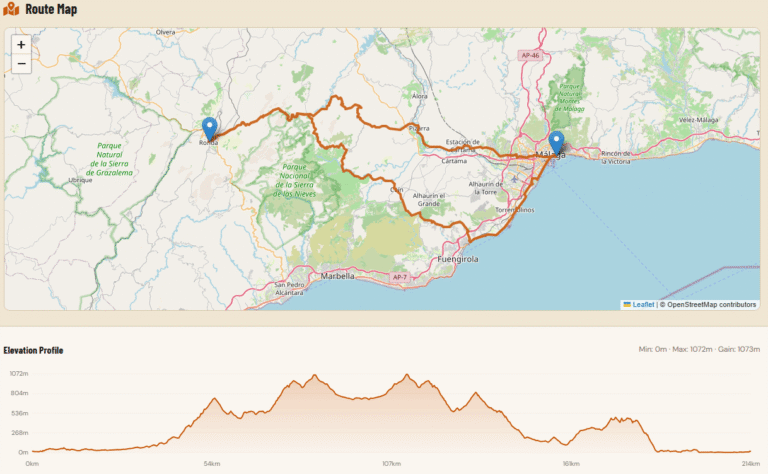
There is a large number of GPX cycling routes available across the Costa del Sol, covering everything from short, high-intensity climbs to long endurance rides deep into the mountains. The region is well documented by cyclists, which means you can find routes starting from key locations such as Cómpeta, Nerja, Torre del Mar, and Málaga.
Distances typically range from 15 km for shorter, focused efforts to well over 180 km for longer endurance routes. Elevation gain varies just as much, from a few hundred meters on coastal rides to more than 3,600 meters on mountainous inland routes. This makes GPX files a powerful tool for planning rides that match specific training goals, whether that is recovery, tempo work, or full-day challenges.
However, not all GPX routes are created equal. A large portion of routes available online are automatically generated or shared without proper testing. These often include unnecessary stops, poor road choices, traffic-heavy sections, or inconsistent flow that disrupts the riding experience.
The best GPX routes are curated and tested. They are built with intention, focusing on road quality, minimal interruptions, and a clear structure that supports consistent effort. These routes allow you to stay in rhythm, manage pacing effectively, and get real training value from your ride.
For riders who want to get the most out of cycling on the Costa del Sol, selecting the right GPX file is just as important as the ride itself. A well-designed route will not only improve performance but also enhance the overall experience, combining efficient training with some of the best scenery the region has to offer.
Best Time to Ride on the Costa del Sol
The Costa del Sol is a true year-round cycling destination, offering consistent conditions that make it possible to train and ride with minimal interruption throughout the year. Unlike northern Europe, where weather often dictates training consistency, this region allows you to maintain structure, volume, and intensity across all seasons.
Winter (October to April) is widely considered the best period for performance-focused riding. Temperatures are mild, typically ranging between 10 and 20 degrees, creating ideal conditions for long endurance rides, threshold work, and high-quality training blocks. The roads are quieter, especially inland, and you can ride for hours without overheating or needing to manage extreme conditions. This is why many professional and amateur cyclists choose the region for winter training camps.
Spring and autumn offer the most balanced conditions overall. Temperatures are slightly higher than winter but still very manageable, making it easier to combine longer rides with higher intensity efforts. The landscape is also at its best during these periods, with clearer air, greener surroundings, and stable weather patterns. For many riders, this is the optimal time to push performance while still enjoying ideal riding conditions.
Summer (June to September) brings significantly higher temperatures, especially inland where climbs can become demanding due to heat. However, riding is still highly effective if approached correctly. Early morning sessions are key, allowing you to train before peak temperatures. Higher altitude routes also provide cooler conditions and make it possible to maintain quality even during hotter months. Coastal rides can work well early in the day, but traffic and heat should be considered.
What truly sets the Costa del Sol apart is the ability to train consistently over time. The stable climate allows for uninterrupted training blocks, which is one of the most important factors in improving cycling performance. Instead of adapting your training to the weather, you can focus on executing your plan, week after week, without compromise.
For riders who value consistency, structure, and predictable conditions, this is one of the strongest cycling environments in Europe.
Want guided cycling tours on Costa del Sol?
Experience the best cycling routes in southern Spain without the guesswork. Guided tours on the Costa del Sol give you direct access to world-class climbs, quiet inland roads, and carefully selected routes designed for performance and experience.
Whether you are looking for a single epic ride, structured training days, or multi-day cycling experiences, each tour is tailored to your level and goals. Focus on riding, pacing, and enjoying the terrain while everything else is handled for you.
Ride smarter, train better, and get more out of every kilometer.